Saturday, April 23, 2016

Looking Inward: Jung, Perception and What is it?

A recent article on The Mind Unleashed by Gary Bobroff offered 5 ways Carl Jung's psychology 
leads us to our inner life. They are: dreams, personality types, archetypes, synchronicity and the "realness" of the unconscious. The essay develops a short explanation of all five and concludes with this statement about the reality of what lies beyond our conscious awareness:

"...there is more to the psyche than just the conscious mind. With this in mind, engagement with the inner voice is pursued not as a form of inner housekeeping, but rather in the humble service of the development of a relationship with an intelligence present within us but greater than our own. Committing to that service means relating more deeply to our inner nature; its only end-goal is the whole-bodied, whole-hearted, full blossoming of who we really are."

I have done quite a bit of research on the mystical or wisdom tradition and its correlation with personality type. My conclusions, completely supported in psychology of religion literature, is that wisdom and mysticism involve  the integrated awareness of both the outer, sensing thinking and the inner, intuiting feeling mind; the latter being an absolute necessity for a balanced appreciation of subjective reality. Mystics are always intuitive perceivers (NF or NT on a Myers-Briggs).

Mr Bobroff goes on to describe Jung's idea of synchronous awareness, prompting my thoughts of the vast realm of subjective reality and our, often limiting and delusional, attempts to objectify what simply cannot be fully defined. That which is beyond objectification and for which words and ideologies must allow accessibility to more expansive interpretation than dogmatic precision seeks to impose.

"Jung’s psychology is only really understood when it is a lived experience, and nothing exemplifies this more than the mystery of synchronicity. Jung coined the term synchronicity to refer to extraordinary moments when outer happenings reflect inner states. What we see in such a coincidence of events is a MEANINGFUL INTERPLAY alive in our reality."


In all cases of spiritual/psychological/social development, we must understand that our identity (and this is way oversimplified I'm sure) exists in relationship with our self, our higher power (that which is beyond the self), and others (people and planet) outside of our self. These relationships can be objectified, as if they are separate from our self, but they are not. What we think, see, hear, smell, touch, taste does not the whole experience compose. There are other perceptions and interactions at work in relational reality beyond what can be objectified. These are interactive energies of memory, emotion, presence, and others I don't even know how to name. These are ancient mechanisms for survival and attunement that are complex, to say the least.

Christof Koch, a researcher of consciousness, proposes that "Any system that possesses some nonzero amount of integrated information experiences something. Let me repeat: any system that has even one bit of integrated information has a very minute conscious experience."

Can you imagine how many integrated systems are operating for you to be reading and understanding this right now?

Spirit is by definition, unseen. We are so stuck on the idea that what is true must be see-able, or thinkable, when in reality all we see or think defines no more than a point in space. One point, no matter how big or small, in an unknown - unknowable eternity of "what is it?" It "is" a point we conjure, alone or together; an object or concept nidus to be agreed upon or argued over. Everything our sensing "sees" is relative, in many ways, not the least of which is how aware we are of our inner world.

"We see only so much of the world as we have apperceptive (introspective) organs for seeing. We see things not as they are but as we are–that is, we see the world not as it is, but as molded by the individual peculiarities of our minds."
The Psychology of Prejudice, Current Literature GTW Patrick, 1890

There is always more. Everything I can discretely perceive with my mind or outward sensing is but a moment manifestation of something beyond the manifestation of "what is it?" Something life giving, as manna to the Israelites. Something life-informing, like the room around me. But not something that lasts forever. "If a tree falls in a forest and no one is around to hear it, does it make a sound?"
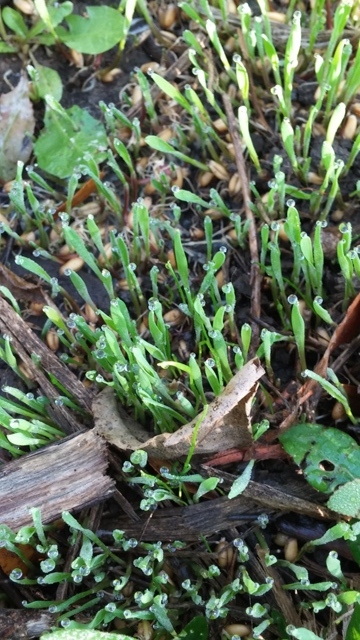

Experience is beyond the objective. It rises and falls into awareness on a sea of subjectivity that is eternal and undefinable. Consciousness is perhaps the best word we have for it right now. Ultimate reality? Absolute Truth? These are all words that are never limited by definition. Like God. Like grace. Like possibility. These are symbols, like every single word we use, they both inform and confound, because subjective experience is built into them...and also beyond them.

Perhaps we should remember to ask, "What is it?" more often. The word manna, literally means, "What is it?" In story it seems to be the substance from which the desert wanderers made bread. It is that which kept them alive, but spoiled in a day and had to be refreshed with the new days supply of "what is it?" Manna, we are told, was the white stuff that appeared like dew on the ground each morning and was gone by noon. The "what is it?" sustained an entire people for 40 years. I think it was more than bread makings. Much more.

_/\_Peggy @ Ecumenicus

Postscript: One of the hallmarks of intuitive inquiry is asking one's self, "What does this mean?" Intuition always looks beyond physicality or superficial circumstance for meaning and value. Both are subjective, remembered, experiential additions to objectified reality.

Taking pause, being quiet, allowing space between the event and the interpretation will assist in bringing intuitive wisdom to the experience. Be still.

Sending all of you joy and peace!

Mind Unleashed article at this link: Five Ways Carl Jung Led Us To The Inner Life

Friday, March 25, 2016

Good Friday

Moraldi
PASSION                                                                               

Beloved, you have kissed
My eyes awake
I am consumed
In a blaze of your being
My embers fly
Freely
At a cost I did not,
cannot,
fathom.

Take me.
I yield willingly, joyfully, urgently
Fuse my essence into yours
Make us something not of this world.
Such a radiance you draw from me
desire as I have never known.
A passion visceral and potent.
Constant as the sun
Fervent to be light.

Stop! I am assaulted by senses of
such woeful orthodoxy
Beat me bloody numb with pain.
Forces of longing and judgment
Ebb and flow as
Fists of turbulence
Sculpt a deep, deep well within
The battleground of mind and flesh
In murky waters of my soul
Devastation like nuclear holocaust
Strips my peace
And feigns to turn my heart against me
All in the name of love.

Who would set a blaze so mighty
That ravages the soul in eternal battle?
Love’s enduring light is wrapped in violent opposition
Powers that resist a blessed consummation
Lest it loose a light so
Great that love is all
All is love.

Neediness be gone!
My heart cannot sustain the fight.
Open my wounds and lay them bare before the fray.
Flush them with sunlight in streams flowing with surrender
Post my longing to a pole
Stretch it wide, wide with time
and pierce me through and through
with swords of eternal light that
Rend my flesh to ash and earth
Restore my truth
My rest
My life.

I cannot live without love.
Death is more than dying flesh
Conforming suffocates life slowly.

© Peggy Beatty, September 11, 2010
                                             ~ ~ ~ ~ ~ ~ ~ ~ ~ ~ ~ ~ ~ ~  ~ ~ ~ ~ ~ ~ ~

Psalm 22. My God, my God, why have you forsaken me?
    Why are you so far from saving me, from the words of my groaning?
2 O my God, I cry by day, but you do not answer,
    and by night, but I find no rest.

3 Yet you are holy,
    enthroned on the praises of Israel.
4 In you our fathers trusted;
    they trusted, and you delivered them.
5 To you they cried and were rescued;
    in you they trusted and were not put to shame.


Alain Villeneuve

Sunday, March 20, 2016

Palm Sunday

As I think on the symbolic events of this week: the parade, the betrayal, the arrest and trial, the killing and the living again, all around me earth is coming to new life. Out my window, the trees are fecund with lime green buds and fragile flowers, dripping their sweet honey, enchantment to bees and butterflies. Daffodils and crocus have risen from brown earth in glorious colors of  
Hallelujah!

                          Hallelujah!

                                                  Hallelujah!  

                                   They wave and dance in the cool March breezes. 

A late snow has come in the darkness of the night. Smooth and sensuous, he kissed each blade of grass and tender bud with sly allure, crooning a lullaby to sing sweet Spring back into her dream sleep. But she will have none of it! Twirling with gusto, she laughs and opens her ruby red lips to drink in the tune, liquid music warmed by dawn’s light.

Arrest? Trial? There will be none for this Lady. She dances on, her parade never ends. She moves through darkness and light with love and assurance. Like a phoenix rises from ashes, she is never laid to rest for any longer than the cycle of Holy Life permits. She does not question, when accused. She has no need to defend herself against that which will ultimately amount to a short term setback. She surrenders and rises again. She can do nothing else. It is who she is.


Life wins! Love wins! The sacred relationships of Life are perpetually on parade. They march forward in one grand chorus of interdependent harmony. And I am just a note, or perhaps a rest, on the score of such miraculous music.


As sleep restores our bodies, so does Life go to her Winter’s rest. This is part of the song. The darkness is an inherent characteristic of the light, and the light, is ever and always, the essence of darkness expressed. Spaces and notes.


Let this be my covenant: to honor the dance of the darkness and light. As in nature, so within the temple of my heart and mind. May I reverence who I am in this sacred Love relationship in ways that steady my soul to extend generosity and compassion to all else. May I surrender my leaves in Autumn and stand stoic and strong through the Winters of Life, as the trees brace themselves against the promise of a blazing winter’s sunset. And may I come to Life over and over again, singing Hallelujah!

                       Hallelujah!

                                                  Hallelujah!

                as beautiful Spring insists on flowering her way to the lazy days of Summer.

Let this be my resurrection song!!


Sending you love and always, peace in the darkness and joy in the light!

_/\_Peggy @ Ecumenicus 


Tuesday, March 1, 2016

Merton's Sophia Wisdom and Natural Contemplation

Dante Gabriel Rossetti, 1874
I am researching the idea of Sophia Wisdom in the writings of Thomas Merton. In his later years,
Merton became quite occupied with Wisdom as an aspect of Christ. Drawing on scripture, such as the Song of Songs, and his extensive study of the Holy Spirit in Eastern Orthodox mysticism, Merton came to find a deep, inherent aspect of humanity that is "eros," a notion far beyond the superficial idea of genital erotic love, and applicable to loving relationship, spiritually expressed in unity with humanity and nature. This is Sophia Wisdom, to know this passion for Divine unity with all of life as "Christ-graced" transformation.

Merton says, "If we believe in the Incarnation of the Son of God, there is no one on earth in whom we are not prepared to see, in mystery, the presence of Christ." (New Seeds of Contemplation) This expression is enlightened mind, the very essence of the concept of "the mind of Christ." (Paul - 1 Cor 2:16)

In his exquisite book called "Sophia, The Hidden Christ of Thomas Merton," Christopher Pramuk shares many great quotes by Merton from various sources, but one in particular is a collection of notes from a class Merton taught on Mysticism, Introduction to Christian Mysticism, at Gethsemane in the 1960s. Here, Merton has compiled a wonderful collection of writings from the church fathers, Roman and Orthodox mystics through the ages on mystical theology, the cosmos, the oikonomia (cosmic household - BTW, the origin of the name of this Blog, Ecumenicus), the Wisdom inherent in humans - "multiformis sapientia" - that which apprehends the wisdom and glory of God:

1. in the spirit of Scripture and not in the letter;
2. in the logoi of created things, not in their materiality;
3. in our own inmost spirit and true self, rather than in our ego;
4. in the inner meaning of history and not in its external (history of salvation, victory of Christ);
5. in the inner sense of the divine judgments and mercies (not in superstitious and pseudo-apocalyptic interpretation of events). (New Seeds of Contemplation, 122 via Sophia by Christopher Pramuk, 142)

I'd like to share with you a slice from Introduction to Christian Mysticism that speaks to the idea of natural contemplation (theoria physike), a practice first mentioned by Evagrius Ponticus (345-399 AD), Christian monk and ascetic, meaning understanding natural order of being from both spiritual and material aspects. Merton holds the ability to unite these paradoxical aspects of the human perception of reality as the essence of Sophia Wisdom. It is in this light that humans realize both their spiritual identity in Divine Being with God and their enfleshed, material identity, each one integrally a part of Divine reality.

"Hence theoria physike (natural contemplation) is a most important part of man’s cooperation in the spiritualization and restoration of the cosmos. It is by theoria that man helps Christ to redeem the logoi of things and restore them in Himself.

This theoria is inseparable from love and from a truly spiritual conduct of life. Man not only must see the inner meaning of things but he must regulate his entire life and his use of time and of created beings according to the mysterious norms hidden in things by the Creator, or rather uttered by the Creator Himself in the bosom of His creation.

The vision of theoria physike is essentially sophianic (Sophia wisdom). Man by theoria is able to unite the hidden wisdom of God in things with the hidden light of wisdom in himself. The meeting and marriage of these two brings about a resplendent clarity within man himself, and this clarity is the presence of Divine Wisdom fully recognized and active in him. Thus man becomes a mirror of the divine glory, and is resplendent with divine truth not only in his mind but in his life. He is filled with the light of wisdom which shines forth in him, and thus God is glorified in him.

At the same time he exercises a spiritualizing influence in the world by the work of his hands which is in accord with the creative wisdom of God in things and in history. Hence we can see the great importance of a sophianic, contemplative orientation of man’s life." (Thomas Merton, An Introduction to Christian Mysticism)

This is a mystical way of perceiving, to hold the duality of spirit (what is unseen) and flesh (what is seen) together in the coincidence of opposites, Heraclitus (535–475 BC), the Coincidentia oppositorum (Nicholas of Cusa, De Docta Ignorantia,1440). In Hinduism this is advaita vedanta, nondualism. In a psychological sense, this is to use both the sensing - thinking mind and the intuiting - experiencing "body" together to fully assess ones reality. This is more than knowledge. This is Wisdom. And it is (attained through) "contemplative orientation."

Mertons book, Introduction to Christian Mysticism is available free at this link.

May you find within you, that silent place where Sophia whispers love and unity, a song of songs from the Beloved to the Beloved. Peace. _/\_Peggy @ Ecumenicus

I am blessed to be hosting a retreat with Madonna Sophia Compton on The Divine Feminine: Sophia Wisdom, Origins and Expressions on March 19th. More info here: Lavender House Events

Sunday, December 20, 2015

Birthing the Divine

Jim Curtis, "Chant"

In advent we journey toward peace through hope, with love and joy. We sink into the quiet of our hearts and minds, as nature, in the northern hemisphere, slows her pace and earth cools in the shortest days of sunlight. The season calls us inward, toward the deep truth of who we are, toward the reconciling of our mind and heart. "Be still!" declares the Holy Darkness, "and wait for the light to come."

Wait. Watch. The coming of the light is inevitable. Pay attention! this is your story.

“You find peace not by rearranging the circumstances of your life, but by realizing who you are at the deepest level.”

~ Eckhart Tolle

Pay attention now to where the birth of Jesus has taken place. This eternal birth takes place in the soul totally in the way it takes place in eternity, neither less nor more. Whatever perfection is to enter the soul, be it divine, unique light or grace or happiness, all of it must come into the soul of a necessity through this birth of divine awareness and in no other way. Wait only for the birth of Christ within yourself, And you will discover all blessing and all consolation, all bliss, all being, and all truth.

~ Meister Eckhart

There is a light that shines beyond all things on Earth, beyond us all, beyond the heavens, beyond the highest, the very highest heavens. This is the light that shines in our heart.

~ Chandogya Upanishad
Art: Jim Curtis

Be aware. You are made in the image of God. Bring that forward. Be the Love and Beauty that you are made to be in the Image of the Creator, to whom you are eternally connected.

May the peace of the Eternal Christ, the Word of  Divine Light be born in your heart this beautiful season.

_/\_Peggy at ECUMENICUS

Saturday, December 12, 2015

Advent by Thomas Merton

Charm with your stainlessness these winter nights,
Sergei Gapon, AFP/Getty Image
Skies, and be perfect!
Fly vivider in the fiery dark, you quiet meteors,
And disappear.
You moon, be slow to go down,
This is your full!

The four white roads make off in silence
Towards the four parts of the starry universe.
Time falls like manna at the corners of the wintry earth.
We have become more humble than the rocks,
More wakeful than the patient hills.

Charm with your stainlessness these nights in Advent,
holy spheres,
While minds, as meek as beasts,
Stay close at home in the sweet hay;
And intellects are quieter than the flocks that feed by starlight.

Oh pour your darkness and your brightness over all our
solemn valleys,
You skies: and travel like the gentle Virgin,
Toward the planets' stately setting,
Oh white full moon as quiet as Bethlehem!

Read this poem slowly. Read it, perhaps two or three times so you can feel into the words and rest deeply into the place from which Merton describes the scene of Advent unfolding. Read and rest with the words until you step out of time and feel yourself  "more humble than the rocks, more wakeful than the patient hills." Smell the sweetness of hay and hear the lowing of the beasts in the barn. And on the vast open mountainside, the sheep graze in a silent starry night. Let the words of the poem, like the coming of the New, pour over you slowly, slowly and gently lift you into the flow of the journey to Bethlehem.


May the serenity of the season surround you ~ Peggy @ Ecumenicus

Friday, November 20, 2015

Intimacy. Identity. Life is Sacred Relationship - Love Yourself In Order to Love Others

Lee Kerttu
More thoughts on the Daily Meditation from Fr Rohr today, on the 12-Step program. 

Father Rohr's meditation refers to this step:

Step 11: Sought through prayer and meditation to improve our conscious contact with God as we understood God, praying only for knowledge of God's will for us and the power to carry that out.

Having had experience with addiction, I can say with all certainty: addiction is always related to an unmet need for love - not from others, from yourself. Remember, when we say "love" we refer in a deep, emotional way, to RELATIONSHIP. 

Addicts, whether blatant substance abuse, sex, gambling, etc., or more subtle, critical, negative, judgmental, distracted, anxious, or otherwise at the mercy of the ego and emotions, all fall seriously into the first category of "Why we suffer" per Buddhist reasoning:

We do not know who we are.

We cannot give our self what we need if we do not know who we are. BEING balanced and peaceful within, being in "union with God," is primary to DOING balanced and peaceful or unitive. I cannot stress how subtle and continuous this work is!

Rohr makes 2 statements in his meditation today that I find ultimately important:

"...addiction emerges out of a lack of inner experience of intimacy with oneself, with God, with life, and with the moment."

"If something is really working for you, then less and less will be required to satisfy you."

Knowing who you are is more than taking a moral inventory. Its making the realization that YOU ARE/HAVE ALL YOU THINK YOU NEED and living into that truth. 

You may like the notion that you are partnered with a Higher Power in this case. It certainly helps to believe so. In fact, it is this relationship that is the foundation for all others. This trust, this confidence, this forgiveness, this compassion - self love lays the groundwork for all our outward expressions of love. So, as Mother Teresa's beautiful prayer says, "In the end, its between you and God." Its always only between you and God. The real, true, authentic you (not the one you are hiding or denying) and God. If you get that part right, everything else seems to fall into place, just as Rohr implies in the second quote above.

Matthew 22:36 “Teacher, which is the greatest commandment in the Law?”
37 Jesus replied: “‘Love the Lord your God with all your heart and with all your soul and with all your mind.’ 38 This is the first and greatest commandment. 39 And the second is like it: ‘Love your neighbor as yourself.’ 40 All the Law and the Prophets hang on these two commandments.”

The first statement in Matthew's quote is about loving yourself or, in others words, loving yourself through a deep, continuously cultivated spiritual relationship with your higher power, whatever name that goes by.

Here is Fr Rohr's second meditation on the 12 Step Program and Intimacy: Experiencing Intimacy

May you realize now that you are a perfect child of the Sacred Universe. "no less than the trees and the stars; you have a right to be here." (Desiderata) May you know yourself as LOVE, the most sacred relationship of life - whole and wisely balanced within, giving expression to whole and wisely balanced without. This is the example of Jesus the Christ, the enlightened one. This is the example of Buddha, the awakened one...and all the wise ones who impart their stories to us so that we may grow into possibility and potential. So that we may "Go placidly amid the noise and haste..." (Desiderata)
Anna Valle

_/\_Peggy @ Ecumenicus